Accounting for ASC 842 in Your Cash Flow Statement
The article "Accounting for ASC 842 in Your Cash Flow Statement" by Jess Vento explains how the statement of cash flows, which details an organization's sources and uses of cash over time, reflects the impact of ASC 842 lease accounting standards on financial reporting and cash flow analysis.
Lease Accounting
Accounting for ASC 842 in Your Cash Flow Statement
By: Jess Vento

Request a Demo
First Name*
Last Name*
Email*
Direct Phone Number*
What best describes your organization?*
Please SelectCPA FirmCompany - Non-ProfitCompany - PrivateCompany - PublicConsulting FirmChartered Accountancy FirmFractional CFOGovernmentPrivate Equity FirmOther
Which product(s) are you interested in?*
- Lease Accounting
- Data Extraction
- FRS 102
- BUCS
Lead Source Detail
UTM Source
UTM Medium
UTM Campaign
We'll only use your personal information to provide the products and services you've requested. From time to time, we'd like to contact you about other products and services that may be of interest to you. If you consent, please tick above to say how you'd like us to contact you.
- I agree to receive other communications from Crunchafi.
In order to provide you the content requested, we need to store and process your personal data. If you consent to us storing your personal data for this purpose, please tick the checkbox below.
- I agree to allow Crunchafi to store and process my personal data.*
You can unsubscribe at any time. See our Privacy Policy for details.
reCAPTCHA
Recaptcha requires verification.
protected by reCAPTCHA
What is the Statement of Cash Flows for 842?
The statement of cash flows provides key information about an organization’s financial health and ability to generate cash. The statement describes the sources and uses of cash during a certain period of time.
The cash flow statement tells users of an organization’s financial statements information about:
- The organization’s ability to generate positive future cash flow
- The organization’s ability to pay its obligations and dividends
- The reasons for differences between net income and cash receipts/payments
- The financial position of the cash and noncash investing and financing transactions during a period
- The cash effect of activities related to operating the entity
- Investing and financing transactions
How Do You Present a Lease on a Cash Flow Statement?
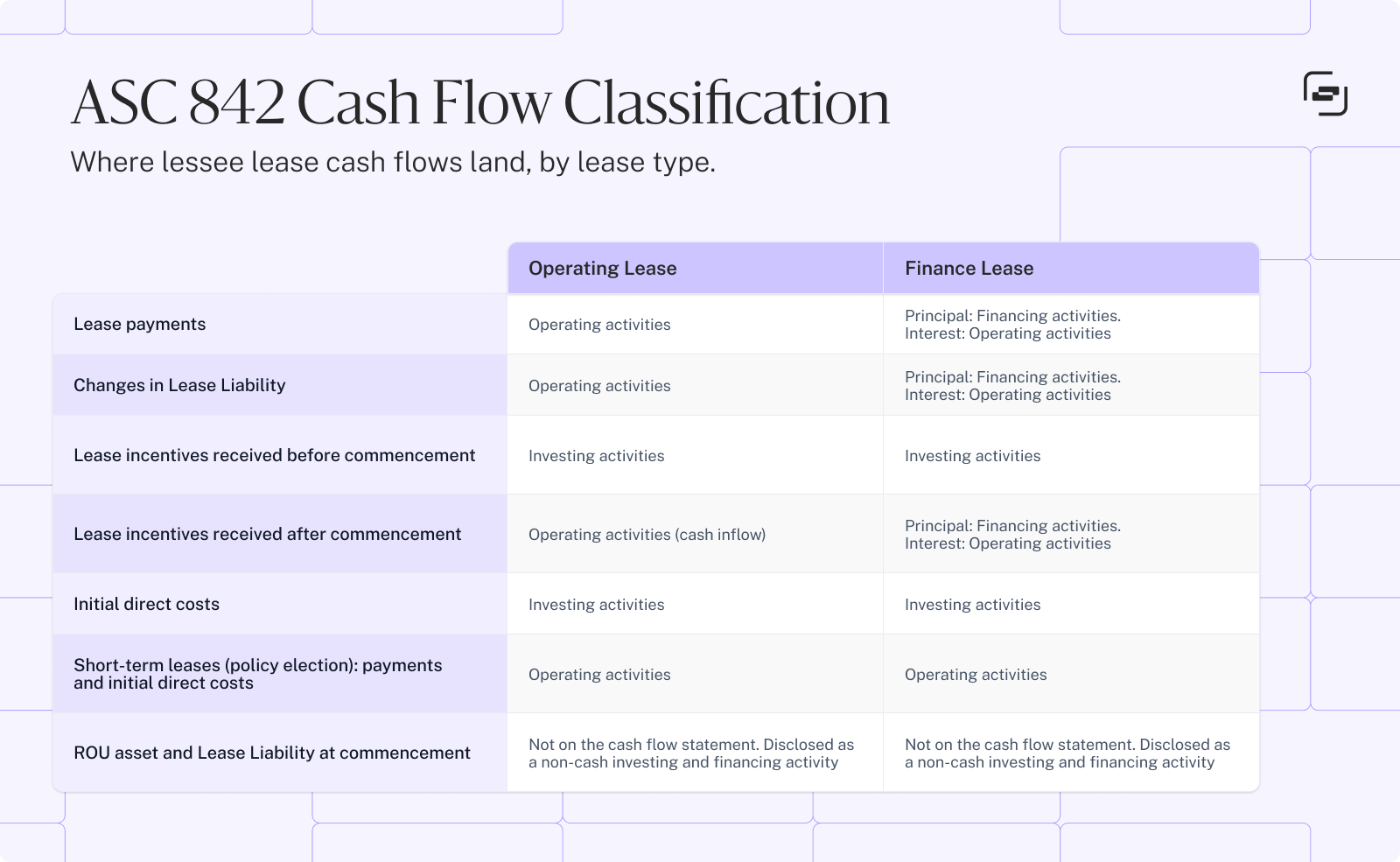
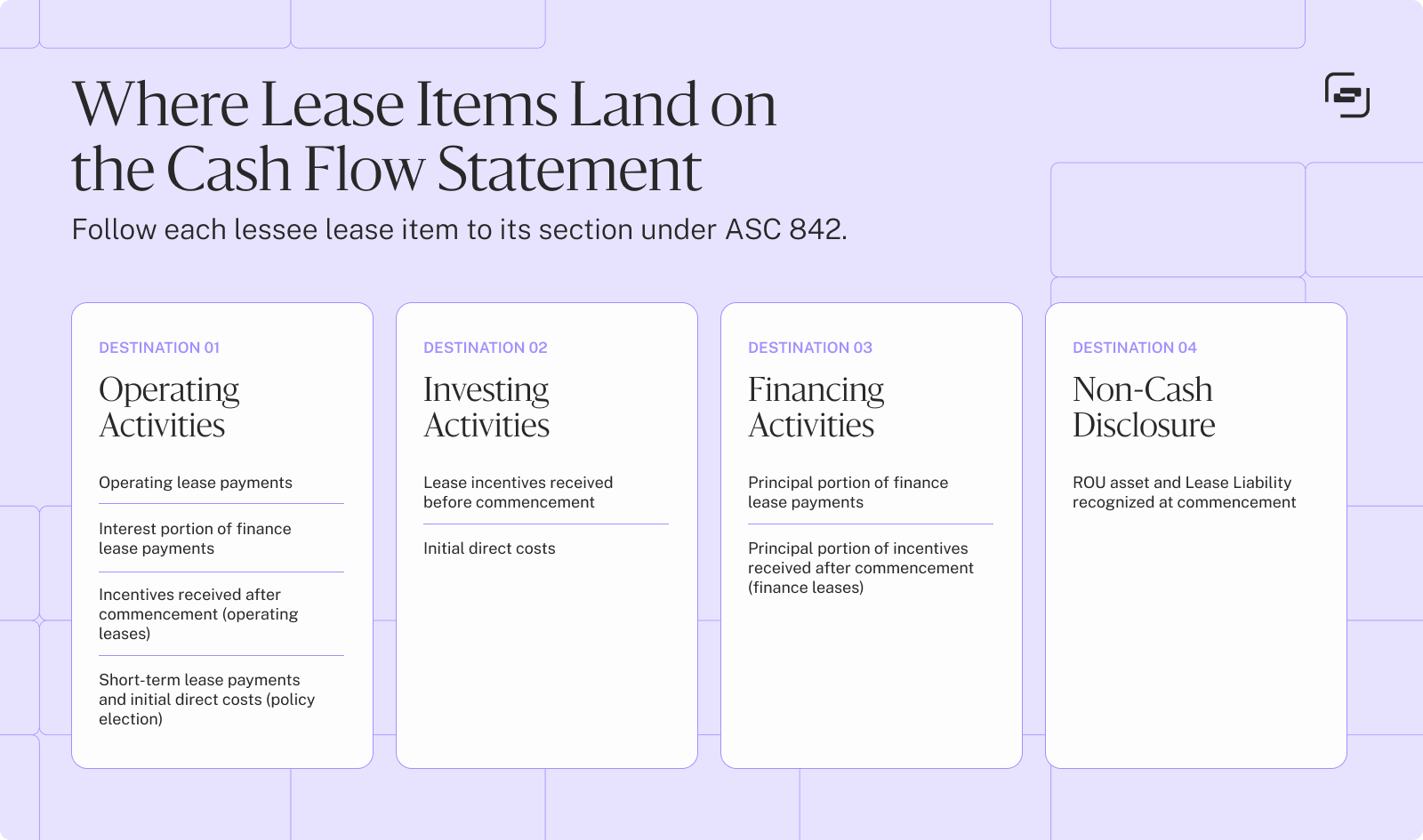
At commencement, a lease is recorded on the Balance Sheet and then presented in the statement of cash flows based on their lease classification. Cash payment or receipts are recorded for operating leases as operating activities and finance leases are reported as financing activities for the principal portion and operating activities for the interest portion.
See: FASB's ASC 842 In Focus PDF
How Does the Recognition of an ROU Asset and a Lease Liability Affect a Lessee and Lessor’s Cash Flow Statements?
The lessee recognizes a lease liability and ROU asset as a non-cash transaction on the balance sheet at the commencement of a lease. The recording of the lease liability and ROU asset is not a transaction that is presented on the cash flow statement; instead, it is disclosed as a non-cash investing and financing activity. Therefore, the initial recognition of an ROU asset and lease liability doesn’t affect a lessee or lessor’s cash flow statement.
How Do You Classify Lease Cash Incentives?
Incentives are payments that the lessor may offer the lessee to get them to agree to sign a lease. Incentives include both payments made by the lessor to or on the behalf of the lessee, and losses incurred by a lessor as a result of assuming a lessee’s pre-existing lease with another lessor. Incentives can also be contingent on future events or lessee actions.
In the cash flow statement, incentives are classified consistent with other lease payments in the contract. The timing of the payment may affect how the incentive is classified on the cash flow statement.
The main guidelines to classifying lease incentives are:
- 1.Incentives received before lease commencement are investing activities regardless of lease classification
- 2.Incentives received after commencement for operating leases are cash inflows from operating activities
- 3.Incentives received after commencement for finance leases are financing activities for the principal portion, and operating activities for the interest portion.
How Do You Classify Cash Flow for Initial Direct Costs?
Initial direct costs are expenses that would not have been incurred if the lease had not been signed. They are included in the initial measurement of the ROU asset and amortized over the lease term.
On the cash flow statement, initial direct costs are cash outflows for investing activities; however, if the lease is considered a short-term lease, the initial direct costs (if there are any) are classified as cash outflows for operating activities, as no ROU asset is recognized.
How Does a Lessee Recognize Lease Payments when the Short-Term Policy Election Applies?
Lease payments or initial direct costs for short-term leases to which the policy election is applied are classified as cash flows from operating activities.
Short-term lease payments are cash outflows from investing activities. These payments exist to cover the costs accrued by bringing another asset to the condition and location necessary for its intended use.
How Do You Show Lease Liability on a Cash Flow Statement?
The lease liability at the commencement of a lease is classified on the balance sheet and disclosed as a non-cash transaction.
When there is a change in lease liability for operating leases, those changes are reported in the statement of cash flows as operating activities. Changes to finance leases are reported as financing activities for the principal portion and operating activities for the interest portion.
How Do You Present a Lease on a Cash Flow Statement?
Leases at commencement are not presented on a cash flow statement; instead, they are disclosed as non-cash transactions. Cash payments or receipts associated with leases are presented as operating, investing, or financing activities within the cash flow statement.
Where Are ROU Assets recorded on the Cash Flow Statement?
ROU assets are classified on the balance sheet and disclosed as a non-cash transaction at the commencement of a lease.
Cash Flow Statement Methods
There are two methods of reporting the statement of cash flows, either direct or indirect method. The presentation of operating cash flows differs between methods, but they result in the same net cash flows from operating activities. The presentation of investing activities and financing activities are identical under both methods..
Under the direct method, major classes of gross receipts and payments are reported to determine net cash flows from operating activities. The direct method requires a reconciliation of net income to net cash flows from operating activities to be presented on a separate schedule. Note that operating cash flows are prepared on the cash basis of accounting.
Organize Your Statement of Cash Flows Under ASC 842 with Crunchafi Lease Accounting
Statements of cash flows can be difficult to keep straight if using good old spreadsheets. Investing in a lease accounting software created and backed by CPA’s and former employees of the Big Four accounting firms to help organizations and companies perform lease accounting accurately and efficiently.
Invest in software that minimizes errors in your lease accounting while also getting a white-glove customer service experience, with experts able to answer your lease accounting questions, whether they’re about statements of cash flows or beyond.
Related resources
Accounting for GASB 87 and GASB 96\ \ Lease Accounting
What are Right of Use Assets?\ \ Lease Accounting
Why CPA Firms Must Embrace Automation & Client-Centric Audits\ \ Lease Accounting
Get the good sheet in your inbox
First Name*
Last Name*
Email*
reCAPTCHA