Lease Accounting Software: What to Look For
The article discusses the importance of lease accounting software in 2027 for CPA firms to ensure compliance with standards like ASC 842, GASB 87/96, FRS 102, and IFRS 16, highlighting its role in replacing error-prone spreadsheets and offering features such as data extraction and tailored solutions for various organization types.
Lease Accounting
Lease Accounting Software: What to Look For in 2027
By: Jess Vento

Request a Demo
First Name*
Last Name*
Email*
Direct Phone Number*
What best describes your organization?*
Please SelectCompany - Non-ProfitCompany - PrivateCompany - PublicConsulting FirmCPA FirmFractional CFOGovernmentPrivate Equity FirmOther
Which product(s) are you interested in?*
- Lease Accounting
- Data Extraction
- FRS 102
- BUCS
Lead Source Detail
UTM Source
UTM Medium
UTM Campaign
We'll only use your personal information to provide the products and services you've requested. From time to time, we'd like to contact you about other products and services that may be of interest to you. If you consent, please tick above to say how you'd like us to contact you.
- I agree to receive other communications from Crunchafi.
In order to provide you the content requested, we need to store and process your personal data. If you consent to us storing your personal data for this purpose, please tick the checkbox below.
- I agree to allow Crunchafi to store and process my personal data.*
You can unsubscribe at any time. See our Privacy Policy for details.
reCAPTCHA
Recaptcha requires verification.
protected by reCAPTCHA
Last updated: October 2026
Lease accounting software helps CPA firms maintain ASC 842, GASB 87/96, FRS 102, and IFRS 16 compliance for their clients without relying on error-prone spreadsheets. With the standard in effect for all entities, the decision facing firms is whether to adopt lease accounting software and which vendor delivers the accuracy, flexibility, and support a growing client base demands.
Key Takeaways
- Lease accounting compliance is an ongoing obligation, and manual spreadsheet processes create risk in reporting.
- The right software should support ASC 842, IFRS 16, FRS 102, and GASB 87/96.
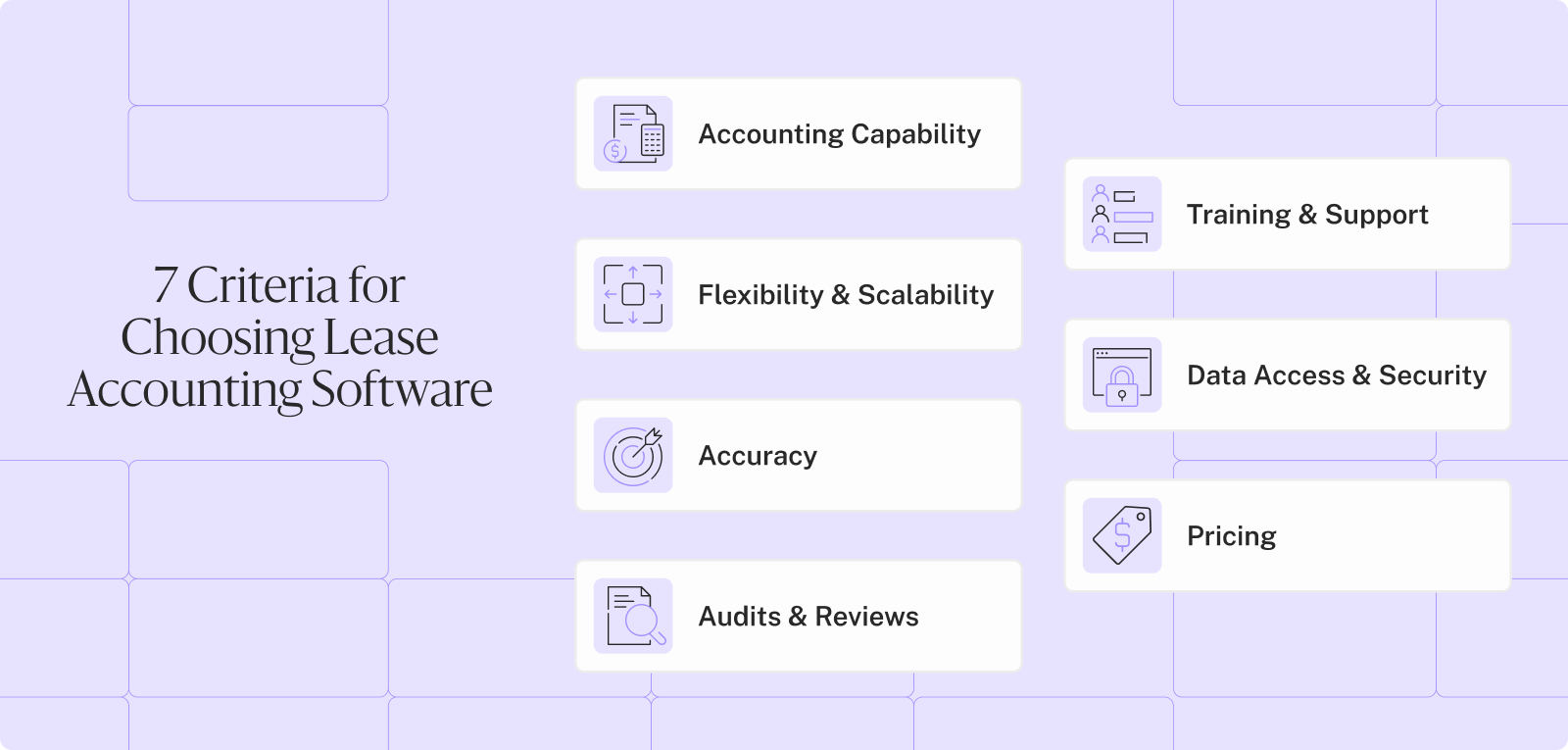
- Evaluate vendors across seven areas: standards coverage, flexibility and scalability, accuracy, audit support, training, data access and security, and pricing.
- Most lease accounting vendors price on a quote-only basis. Crunchafi publishes transparent per-lease pricing with no minimums, setup, training, or implementation fees.
- Implementation speed varies widely by vendor, from a couple of business days to several months, and it directly affects how quickly a firm can start billing the engagement.
- Firms serving multiple clients need dual-access capability so the firm and its clients can work in the same system without duplicating data entry.
Since the new lease accounting standards took effect for all entities, spreadsheets have become quite risky for firms. Manual tracking means managing years of amortization schedules, modifications, and remeasurements by hand. For CPA firms advising clients on the standard, choosing a platform that keeps ongoing compliance as your client base grows is crucial.
Consider the following areas when comparing lease accounting software.
How Lease Accounting Software Vendors Compare
The graphic below compares four commonly evaluated lease accounting software platforms across the criteria this guide covers. Pricing and feature details for competitors reflect publicly available vendor and third-party review information as of 2026.
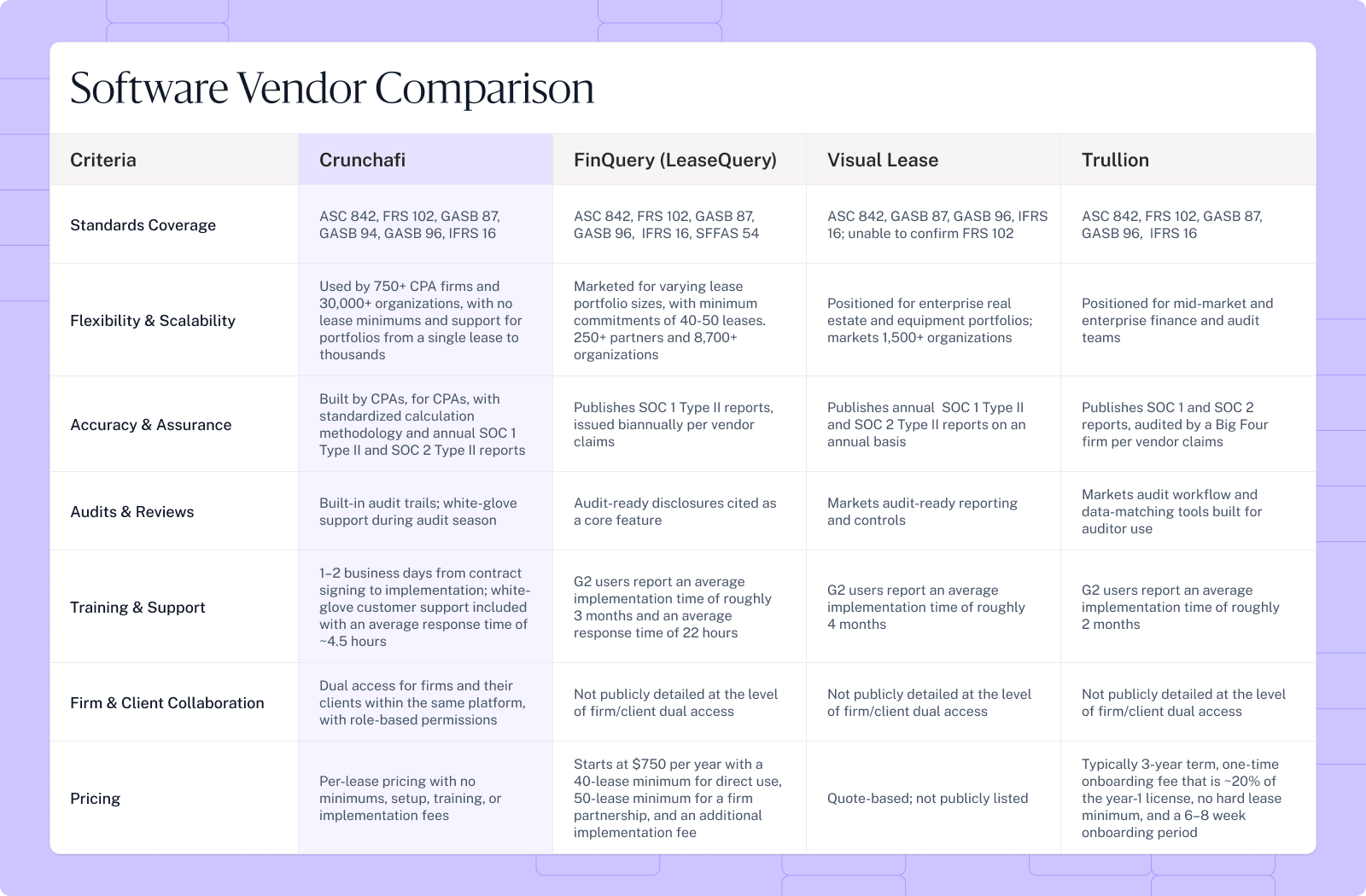
Sourcing note: Competitor data is drawn from vendor websites, G2, and Crunchafi internal research as of 2026. Implementation-time figures for FinQuery, Visual Lease, and Trullion are G2 user-reported averages and research conducted by Crunchafi.
What Should Lease Accounting Software Cover for ASC 842, IFRS 16, FRS 102, and GASB 87/96?
Compliance is still the most important factor when evaluating software, but by 2027 it's table stakes. Depending on your client mix, you may need to support FASB (ASC 842), IASB (IFRS 16), FRC (FRS 102) standards, plus GASB 87/96 if you serve government entities.
Look for a platform that can:
- Generate monthly journal entries and import them directly into the accounting system
- Perform the quantitative calculations required under current lease disclosure requirements
- Prepare lease amortization schedules covering all required accounts, including the ROU Asset, short-term and long-term Lease Liability, interest expense, and amortization expense
- Customize account numbers and descriptions to match each client's chart of accounts and journal entry format
- Simplify and document policy elections
- Offer standard and customizable reporting across every lease type your clients hold
How Flexible and Scalable Should Lease Accounting Software Be for CPA Firms?
Your firm's client base is not one-size-fits-all, and your software shouldn't force it to be. As you evaluate flexibility and scalability, ask:
- Is the software built for one industry or asset type, or can it handle the mix across your client roster?
- Can you attach documents and notes directly to a lease record so all context lives in one place?
- Does the platform work equally well for a client with five leases and one with five hundred, including varying complexity of terms and provisions?
- How many users can access the platform, and does that scale with your firm's growth?
How Do You Ensure Lease Data Accuracy?
Accurately entering existing lease data is one of the most consequential steps in adopting new software, since an error at data entry compounds across every future amortization period. Look for:
- Validations and guided wizards that catch errors as data is entered
- Tooltips and in-context hints that walk users through calculations
- Bulk-import templates for populating an initial lease portfolio
- A documented methodology for how the vendor verifies calculation accuracy, including whether an Agreed-Upon Procedures report is available
- Transparency into whether the vendor maintains a third-party SOC report
How Does Lease Accounting Software Simplify Audits and Reviews?
One of the clearest advantages of software over spreadsheets is a simpler audit and review process. Confirm the platform includes built-in audit trails and reporting options that let you trace every input back to its source. If your firm provides hosting services as part of an engagement, also confirm the system complies with AICPA guidelines so your independence as a CPA firm isn't put at risk.
What Training and Support Should You Expect From a Lease Accounting Vendor?
Implementation and ongoing support determine how quickly a new client engagement can start generating value, which matters directly to firm profitability. Before signing, ask:
- How long does implementation typically take, from contract signing to go-live?
- What self-service training is available, such as guides or narrated walkthroughs?
- Can additional training be purchased or accessed later as your team grows?
- Is ongoing support included, and does the support team actually understand lease accounting, or are they generalist reps reading from a script?
- Are there hidden costs attached to training, implementation, or support?
How Should CPA Firms Evaluate Data Access and Security?
As a firm working with clients on ASC 842 compliance, you need software that supports collaboration. Confirm whether single sign-on is available across clients, and whether your firm and each client can access the same lease data without duplicate entry. On the security side, don't assume every vendor's protocols are equivalent. Ask directly about data security practices and what standards the vendor's infrastructure is held to.
What Does Lease Accounting Software Cost?
Pricing is often the deciding factor, but it's also where lease accounting vendors are least transparent. Most vendors in this category price on a custom quote basis, which means you can't build a budget estimate without a sales conversation. When you do get a quote, ask:
- Are there additional fees for implementation, training, or support?
- Is full functionality included in the base price, or are modules priced separately?
- Is pricing structured per user, per lease, or as a flat annual fee?
Crunchafi's Lease Accounting software is priced per lease, with no minimums and no setup, training, or implementation fees, which makes budgeting for a new client engagement more predictable than the quote-only model common across the category.
Frequently Asked Questions
What is lease accounting software?
Lease accounting software is a platform that automates the calculations, journal entries, and disclosures required to comply with lease accounting standards like ASC 842, IFRS 16, and GASB 87/96.
Is lease accounting software required to comply with ASC 842?
Software is not legally required, but ASC 842's disclosure and remeasurement requirements make manual spreadsheet tracking risky at scale. Software helps firms maintain compliance.
How much does lease accounting software cost?
Pricing varies by vendor and is usually structured per lease, per user, or as a custom quote. Most vendors in this category do not publish pricing publicly.
How long does it take to implement lease accounting software?
Implementation timelines range from a few business days to several months depending on the vendor and the complexity of the lease portfolio being migrated.
Can one platform handle both ASC 842 and GASB 87 leases?
Yes. Most established lease accounting platforms, including Crunchafi, support multiple standards, which matters for CPA firms whose client base spans private companies and government entities.
Can multiple people at my firm and at a client access the same lease data?
This depends on the vendor. Look specifically for dual-access capability that lets your firm and your client work in the same system without re-entering data, rather than assuming every platform supports this by default.
How Lease Accounting Software Vendors Compare
Lease Accounting Software Comparison Table: Crunchafi vs. FinQuery, Visual Lease, and Trullion.
| Criteria | Crunchafi | FinQuery (LeaseQuery) | Visual Lease | Trullion |
|---|---|---|---|---|
| Standards Coverage | ASC 842, FRS 102, GASB 87, GASB 94, GASB 96, IFRS 16 | ASC 842, FRS 102, GASB 87, GASB 96, IFRS 16, SFFAS 54 | ASC 842, GASB 87, GASB 96, IFRS 16; unable to confirm FRS 102 | ASC 842, FRS 102, GASB 87, GASB 96, IFRS 16 |
| --- | --- | --- | --- | --- |
| Flexibility & Scalability | Used by 750+ CPA firms and 30,000+ organizations, with no lease minimums and support for portfolios from a single lease to thousands | Marketed for varying lease portfolio sizes, with minimum commitments of 40-50 leases. 250+ partners and 8,700+ organizations | Positioned for enterprise real estate and equipment portfolios; markets 1,500+ organizations | Positioned for mid-market and enterprise finance and audit teams |
| --- | --- | --- | --- | --- |
| Accuracy & Assurance | Built by CPAs, for CPAs, with standardized calculation methodology and annual SOC 1 Type II and SOC 2 Type II reports | Publishes SOC 1 Type II reports, issued biannually per vendor claims | Publishes SOC 1 Type II and SOC 2 Type II reports annually | Publishes SOC 1 and SOC 2 reports, audited by a Big Four firm per vendor claims |
| --- | --- | --- | --- | --- |
| Audits & Reviews | Built-in audit trails; white-glove support during audit season | Audit-ready disclosures cited as a core feature | Markets audit-ready reporting and controls | Markets audit workflow and data-matching tools built for auditor use |
| --- | --- | --- | --- | --- |
| Training & Support | 1 to 2 business days from contract signing to implementation; white-glove customer support included with an average response time of ~4.5 hours | G2 users report an average implementation time of roughly 3 months and an average response time of 22 hours | G2 users report an average implementation time of roughly 4 months | G2 users report an average implementation time of roughly 2 months |
| --- | --- | --- | --- | --- |
| Firm & Client Collaboration | Dual access for firms and their clients within the same platform, with role-based permissions | Not publicly detailed at the level of firm/client dual access | Not publicly detailed at the level of firm/client dual access | Not publicly detailed at the level of firm/client dual access |
| --- | --- | --- | --- | --- |
| Pricing | Per-lease pricing with no minimums, setup, training, or implementation fees | Starts at $750 per year with a 40-lease minimum for direct use, 50-lease minimum for a firm partnership, and an additional implementation fee | Quote-based; not publicly listed | Typically 3-year term, one-time onboarding fee that is ~20% of the year-1 license, no hard lease minimum, and a 6 to 8 week onboarding period |
| --- | --- | --- | --- | --- |
Related resources
Accounting for GASB 87 and GASB 96\ \ Lease Accounting
What are Right of Use Assets?\ \ Lease Accounting
Why CPA Firms Must Embrace Automation & Client-Centric Audits\ \ Lease Accounting
Get the good sheet in your inbox
First Name*
Last Name*
Email*